

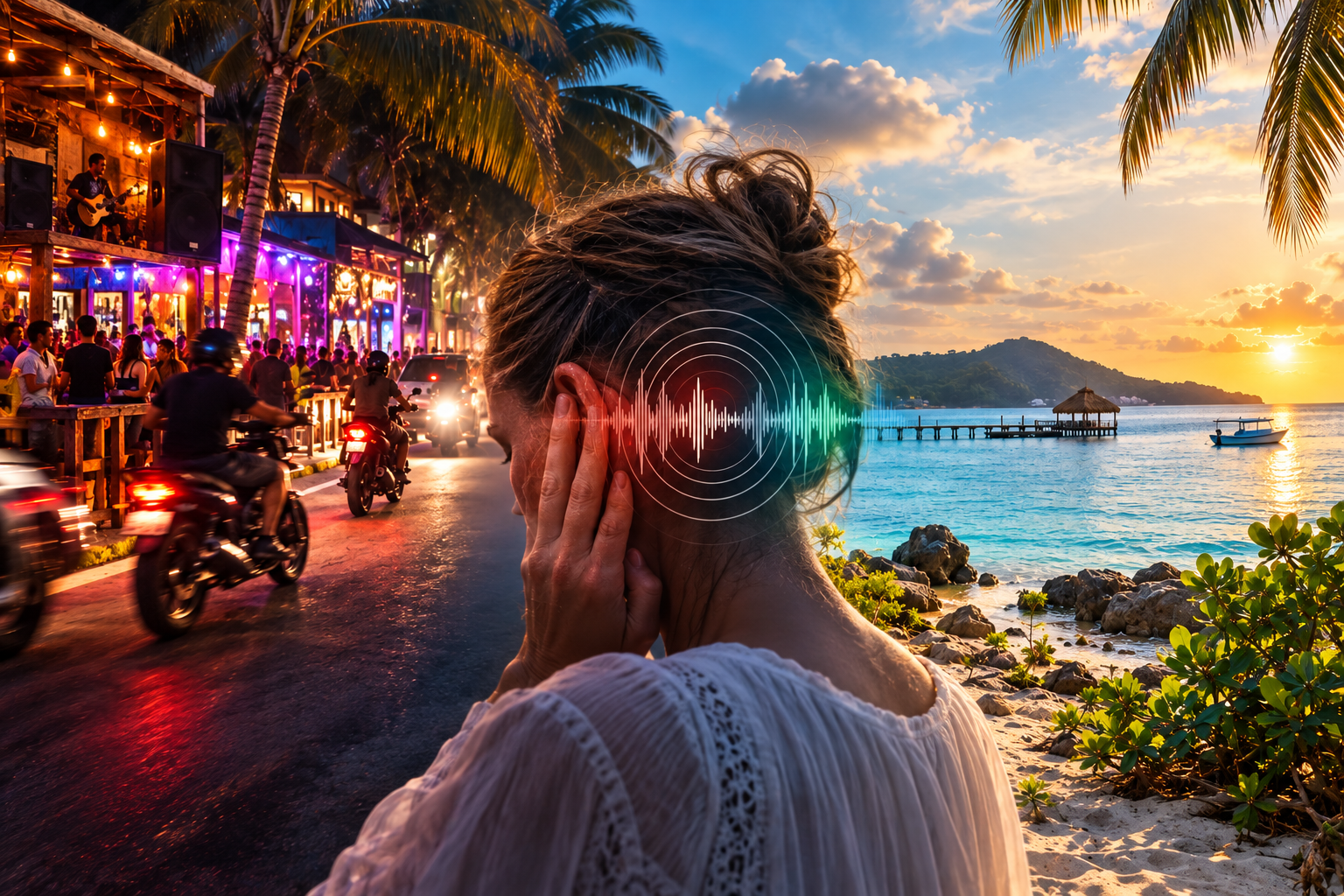
Protecting Roatan’s Hearing, Health—and the Peace Paradise Requires
When I lived in the peaceful village of Sandy Bay in the early 1990s, roosters crowed, dogs barked, and occasionally a teenager played a boombox louder than necessary. Those were among the loudest sounds in the neighborhood.
Nearly four decades later, I still come to Roatan searching for that soothing, peaceful paradise. With each visit, however, its quiet seems harder to find.
Amplified music spills from restaurants and bars into neighborhoods. Motorcycles and vehicles with roaring exhausts shatter the night. And unlike the crow of a rooster, some of that noise can leave lasting damage.
Like many seniors, I live with tinnitus, a relentless ringing that makes loud sound physically distressing. Post-traumatic stress can intensify that reaction.
But this is not merely an issue for people with tinnitus, war veterans, or older residents.
Excessive noise affects all of us—and some of the damage it causes cannot be undone.
The Damage We Cannot Undo
Deep inside the inner ear are thousands of delicate sensory hair cells that convert vibrations into electrical signals the brain interprets as sound. Excessive noise can damage or destroy them, and in humans these cells do not naturally regenerate.
Young ears are not immune. A 2023 analysis of eight studies involving 1,950 college students found measurable hearing loss in nearly one in five. Among college musicians—young people repeatedly exposed to loud sound—the figure at one high frequency reached a startling 85 percent.
We get one pair of ears for a lifetime. What excessive noise destroys, medicine cannot simply give back. The World Health Organization warns that more than one billion people ages 12-35 are at risk of hearing loss from unsafe recreational sound.
The World Health Organization warns that more than one billion people ages 12-35 are at risk of hearing loss from unsafe recreational sound.
The hearing you damage at 18 may be the hearing you desperately wish you still had at 70 when you strain to hear the voices of your grandchildren.
Hearing aids and cochlear implants can help many people communicate and hear more effectively, but they cannot restore damaged inner-ear hair cells.
Noise-induced hearing loss can also be deceptive. You leave a deafening bar, party or concert with muffled hearing or ringing in your ears. By morning, you may think everything is fine.
So you do it again.
And again.
And again.
Years later, conversations become harder to follow. Voices blur in crowded rooms. You turn the television louder. Or perhaps the ringing that once disappeared after a noisy night no longer disappears.
The motorcycle is gone.
The restaurant has closed.
Everyone else has gone to sleep.
But the sound inside your head continues.
You can leave the noise. The noise may not leave you.
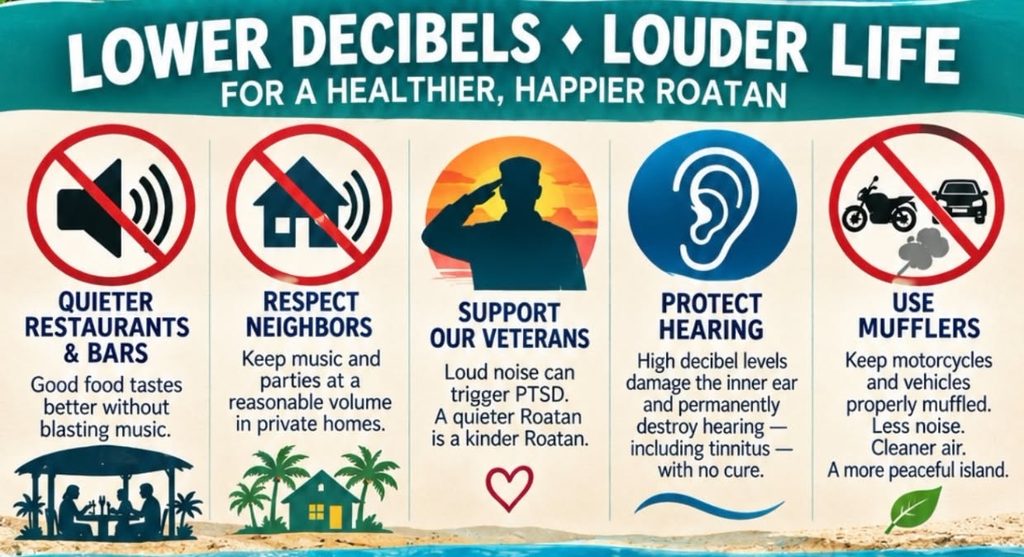
Noise Affects More Than Hearing
Unwanted environmental noise can interfere with sleep, concentration, and communication, while increasing stress. Chronic exposure is even associated with harmful cardiovascular effects.
I have known villagers kept awake until two in the morning by music from local resort bars, only to rise four hours later for a full day of work. Many neighborhoods have a party house where blasting music is a nightly occurrence. Night after night, lost sleep extracts a price—in health, concentration, mood and patience.
For some people loud noise can trigger severe physical and emotional distress, making ordinary places difficult—or sometimes impossible—to tolerate.
For some people loud noise can trigger severe physical and emotional distress, making ordinary places difficult—or sometimes impossible—to tolerate
A veteran with post-traumatic stress may hear the explosive crack of a motorcycle exhaust, and, for an instant, be transported back to combat. The brain may recognize a motorcycle; the body reacts to a sound it once learned meant danger.
Someone with tinnitus may stop going to restaurants because another evening of amplified music simply isn’t worth the physical distress that includes debilitating fatigue.
Older residents may stop attending community events. Families may leave restaurants because their children are covering their ears. Renters may lie awake while the bass from a party across the bay pounds through their walls.
The Boom! Thump! Boom! of a blasting bass can steal the sleep they needed to enjoy their hard-earned vacation.
And this is where noise pollution becomes more than a health issue. It becomes an economic issue for Roatan.
Roatan offers something increasingly rare in the modern world: escape to a peaceful place. Visitors spend thousands of dollars to trade traffic, congestion and stress for turquoise water, palm trees, coral reefs, and rest. If they cannot sleep at night, talk over dinner or sit beside the Caribbean without competing with amplified music and roaring exhausts, we are damaging part of the very experience we ask them to come here to enjoy.
Somewhere along the way, some people began confusing loud with good.
A talented musician does not become more talented at 110 decibels. A restaurant does not serve better food because customers have to shout across the table. And a motorcycle does not become more impressive because three villages heard it coming.
There is a difference between sound and noise.
Sound enriches our lives.
Noise is sound imposed upon someone else.
Peace is one of Roatan’s natural resources.
And we are losing it.
The Good News: Roatan already has a law.
The Municipality of Roatan’s 2025 Plan de Arbitrios prohibits disturbing neighbors with excessive noise and establishes sound limits for entertainment establishments and residential areas. The plan also provides separate fines for residents who disturb the peace of their neighbors. It also provides escalating penalties for violations. For public entertainment establishments, the plan specifies limits of 90 decibels inside, and 70 decibels outside. In residential areas, the limits are 65 decibels inside and 40 decibels outside. Business penalties escalate from L.5,000 for a first violation, L.10,000 plus a 15-day closure for a second, to L.20,000 plus definitive closure for a third.
The problem, then, is not simply writing another law. It is turning the law Roatan already has into quieter days and nights.
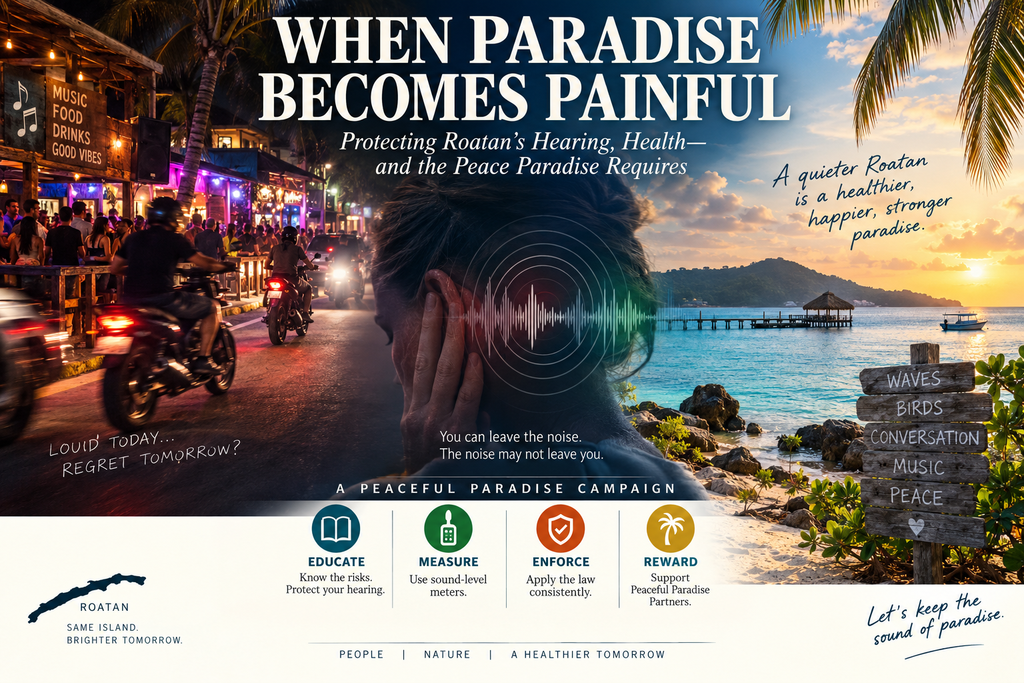
A PEACEFUL PARADISE Campaign
Imagine a highly visible island-wide campaign built around four simple words:
EDUCATE. MEASURE. ENFORCE. REWARD.
EDUCATE: Teach schoolchildren, business owners, DJs, musicians, drivers and residents what excessive noise does to hearing—and that hearing damage can last a lifetime.
MEASURE: Equip trained municipal officers with calibrated sound-level meters and establish a consistent procedure for measuring excessive noise and responding to complaints.
ENFORCE: Apply existing sound limits and escalating consequences consistently. Vehicle owners with defective or deliberately modified exhaust systems should be required to correct the problem before returning to normal operation, using whatever inspection and enforcement authority is available under applicable law.
REWARD: Give restaurants, bars, resorts and other businesses that voluntarily maintain responsible sound levels a highly visible Peaceful Paradise Partner emblem to display.
This campaign should not merely punish bad behavior. It should make offering a peaceful environment a point of pride.
Imagine visitors recognizing the Peaceful Paradise Partner emblem at the entrance to a restaurant and knowing:
Here I can enjoy the music—and still converse with my dining companions.

The goal is not a silent Roatan.
This is the Caribbean. Let the music play. Let people dance. Let them celebrate.
But music can be joyful without being painful. Motorcycles can carry people without announcing themselves to an entire village. Restaurants can create atmosphere without destroying conversation. And people can celebrate without forcing everyone within earshot to join the party.
Development will continue. Traffic will increase. Tourism will grow. We cannot preserve every part of the Roatan we knew decades ago.
But we can preserve its peace.
We protect the reef because it is precious. We protect the beaches because they belong to Roatan’s future. We protect the wildlife because once something irreplaceable is lost, regret cannot bring it back.
It is time to protect the soundscape,too.
Roatan’s natural soundtrack is part of its beauty: waves breaking across the reef, rain whispering through palm leaves, birds greeting the morning, children playing, a guitar drifting from the beach, conversation floating from a waterfront restaurant.
Those are the sounds of an island alive.
What Roatan does not need is noise loud enough to drown out the island’s soothing soundscapes.
When constant noise becomes normal, we may not recognize what we have lost until residents retreat behind closed doors and visitors begin searching elsewhere for the peace they once found here.
We call Roatan paradise.
Now let’s make it sound like one.
The author of the article:

Edwina Doyle Willis is a former high school and college instructor, speechwriter and public relations liaison for the Kentucky Department of Education, Fulbright Scholar to India, and author of eight books and numerous magazine articles.
Here is the link to her latest book, Roatan Remembered:
Amazon
BookBaby
Other articles at BIM by the author:
Tino and Alejo Monterroso – Legendary Dive Masters of the Bay Islands
A Garifuna with Grit Makes Honduran History