

By Angela Claire Bjoroy-Karlsen
Past President of Roatan Utila Guanaja
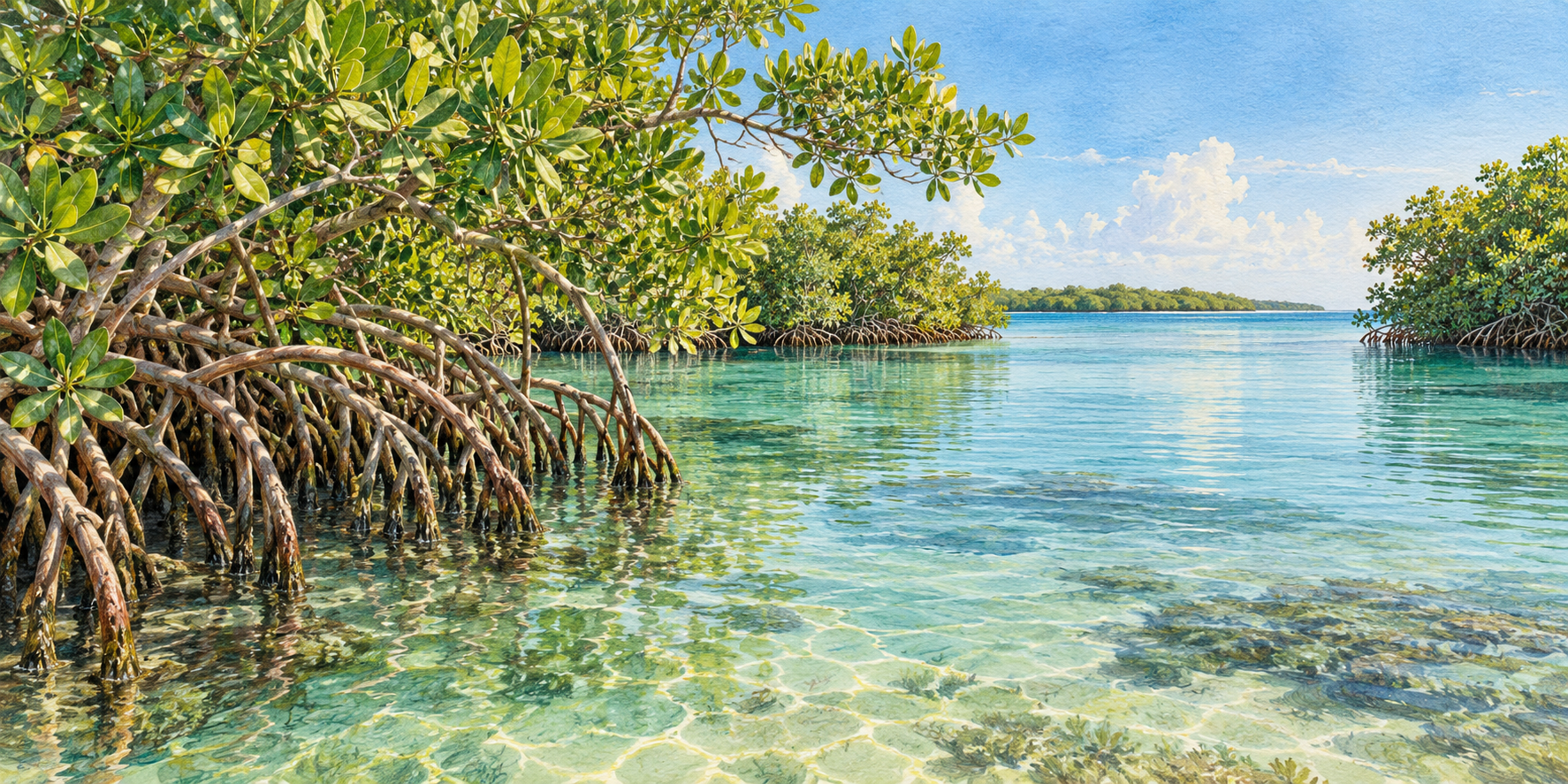
Rotary and Rotaract are joining forces to expand BICA Utila’s mangrove nursery and support the island’s coastal environment.
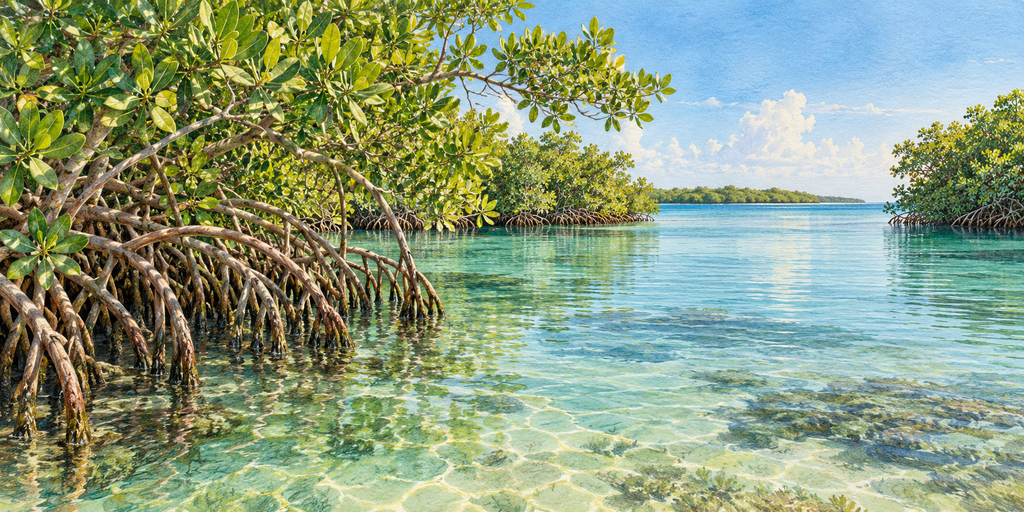
Mangrove forests help stabilize shorelines and shelter coastal wildlife. AI-generated illustration.
Our next major environmental project takes us to Utila. The Rotary Club of Roatan Utila Guanaja is partnering with the Rotaract Club of Tegucigalpa to build a growing house for mangroves, in collaboration with the Bay Islands Conservation Association (BICA).
Protecting coastlines and climate
Mangroves are a fundamental part of our coastal environment. Their roots help stabilize shorelines, reduce erosion and soften the impact of waves and storm surges. They provide food and shelter for wildlife and support coastal livelihoods through fishing and tourism. By trapping sediment and helping filter runoff, healthy mangrove forests also contribute to cleaner coastal waters.[1]
These forests also help address climate change. They capture carbon in their trees and roots and store large amounts in waterlogged soils. Protecting this “blue carbon” helps keep it out of the atmosphere.[2]
Why Utila needs action
Between 2001 and 2025, Utila lost approximately 75 hectares (185 acres) of tree cover to fires and 110 hectares (272 acres) to other causes, according to Global Nature Watch. These figures describe tree-cover loss across the island, rather than mangrove loss alone.[3]
Living nurseries beneath the surface
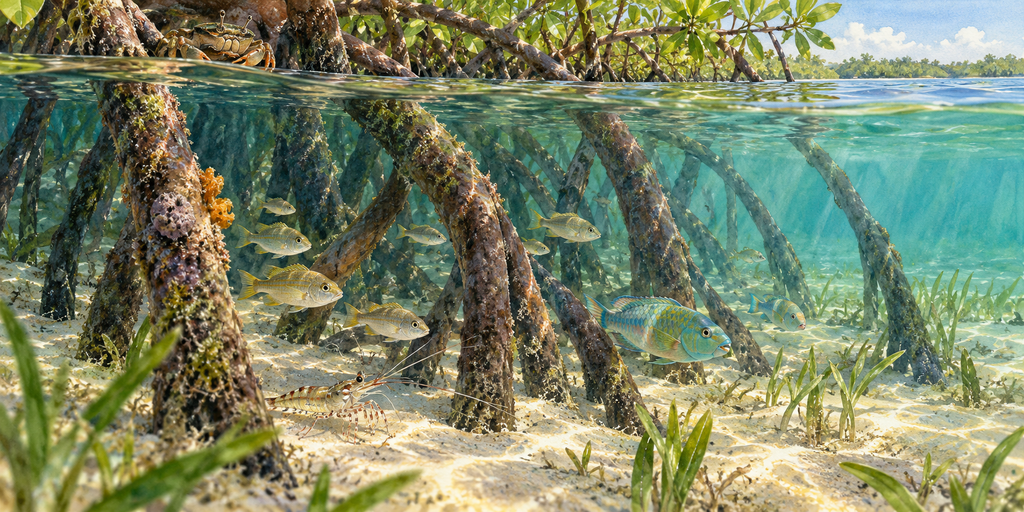
Mangrove roots shelter young fish and other marine life. AI-generated illustration.
Mangrove roots create a sheltered world for algae, sponges, crabs, shrimp and young fish, while the branches above offer nesting and roosting sites for coastal birds. For many reef fish, these sheltered waters provide a place to feed and grow before moving into other habitats.
In a study published in 2012, Jessica Jaxion-Harm, James Saunders and Martin R. Speight examined fish communities in mangroves, seagrass beds and coral reefs around Utila and Cayos Cochinos. Juvenile fish were characteristic of mangrove and seagrass habitats. Young schoolmaster snapper were found primarily in mangroves before moving to coral reefs, while striped parrotfish occurred in all three habitats.[4]
For our project, the study reinforces the value of protecting these connected coastal habitats.
Lessons from Guanaja
After Hurricane Mitch struck Guanaja in 1998, 97 percent of the island’s mangroves were classified as dead. Long-term monitoring began in 2005, and Thomas Fickert’s 2018 study documented how recovery differed among locations.[5]
This research offers encouragement, while reminding us that restoration must suit local conditions. Later work comparing planting with natural regeneration on Guanaja also shows why planting alone should never be treated as a guarantee of success.[6]
Doubling the nursery capacity
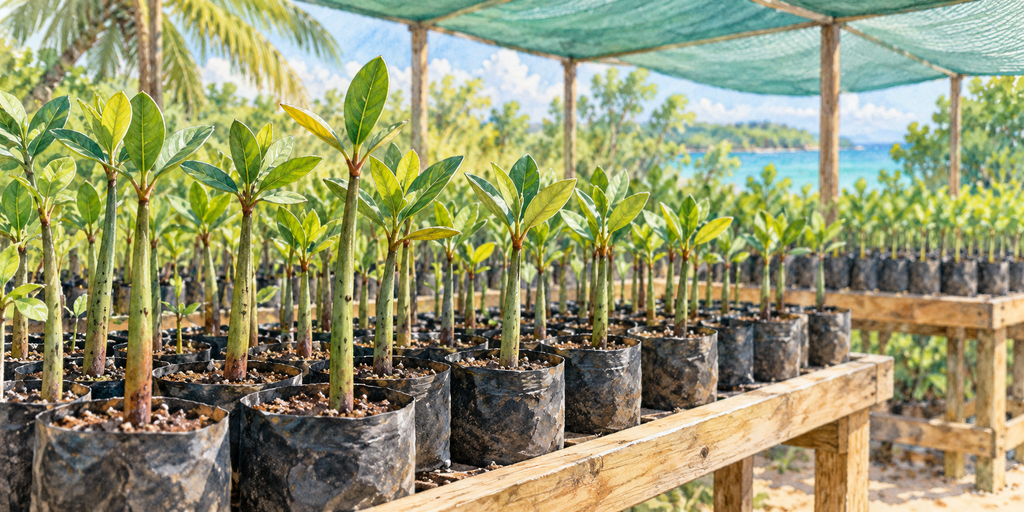
Concept illustration of young mangroves in a growing house. AI-generated.
Our project will expand the capacity of BICA’s mangrove nursery on Utila from 1,350 to 2,700 plants. The growing house will provide additional space for young mangroves, supporting the nursery’s contribution to habitat restoration.
Both clubs will work with BICA throughout planning and implementation. Once the project is complete, the finished facility will be handed over to BICA.
Supporting coastal livelihoods
The long-term aim reaches beyond increasing the number of plants. By supporting mangrove restoration and habitat protection, we hope to strengthen the coastal ecosystems that fish depend on and help sustain local families who rely on fishing for food and income.
Healthier mangroves can also support tourism and help protect the coastal places where people live and work.
The Rotary Club of Roatan Utila Guanaja is grateful to the Rotaract Club of Tegucigalpa for inviting us to partner on this project. Together with BICA, we look forward to helping Utila’s mangroves grow.
Sources
[1] NOAA Fisheries (2018). International Mangrove Conservation Day.
[2] NOAA Fisheries. Protecting Coastal Blue Carbon Through Habitat Conservation.
[3] Global Nature Watch. Utila tree-cover loss dashboard, 2001–2025.
[4] Jaxion-Harm, Saunders and Speight (2012). Fish habitat use in Honduras.
[5] Fickert (2018). Regeneration of storm-disturbed mangroves on Guanaja.
[6] Fickert (2020). Reforestation and natural regeneration on Guanaja.